PCSP Assistant
Pro
01 // The Challenge
Drafting a single goal by hand meant cross-referencing eighteen required clinical domains across disconnected systems — 15–20 minutes of careful, correct work, every time. At peak caseload, that overhead compounded fast: documentation wasn't a task on the list. It was the list.
Each PCSP required documenting eighteen clinical domains with precision. Missouri state auditors require specific active language structures — "Staff will provide instructional support to learn how to use the AAC device" rather than "will try to improve communication". That standard left zero margin for error — one inconsistently worded goal, in a plan with dozens of them, could trigger a revision cycle, another delay, and another week before services could begin for the individual waiting.
The Administrative Burden
Case managers spent 15–20 minutes per goal across eighteen required clinical domains — demographics, communication profiles, personal preferences, relationships, health risk, and measurable outcomes — entirely by hand, in disconnected systems. A plan with multiple goals could take hours to produce, even before the audit review that followed. The result was documentation fatigue that consumed the time and energy meant for the people case managers were there to serve.
The Compliance Gap
State auditors require rigorous Active Treatment language, structured communication profiles, and documented person-centered supports. Any gap — vague phrasing, a missed communication barrier, an undocumented natural support — carried real cost: delayed services and compounding audit risk on plans that had already taken hours to write.
The HIPAA Constraint
Standard cloud tools — Notion, Google Docs, shared drives — were prohibited. No BAA, no compliance. Any solution handling PHI had to meet HIPAA's Security Rule without transmitting data to any external server. That constraint ruled out virtually every off-the-shelf tool on the market. It also meant session management, idle timeouts, and PHI retention policies all had to be engineered client-side.
02 // The Solution
The answer wasn't a SaaS platform or an enterprise system. It was a single HTML file.
I engineered PCSP Assistant Pro as a Zero-Footprint Logic Engine — a clinical drafting tool that runs entirely in the browser's volatile RAM. It processes sensitive PHI locally, generates Missouri-compliant narrative language in real time, and leaves no trace when the tab closes. No servers. No POST requests. No IT tickets. No licensing cost.
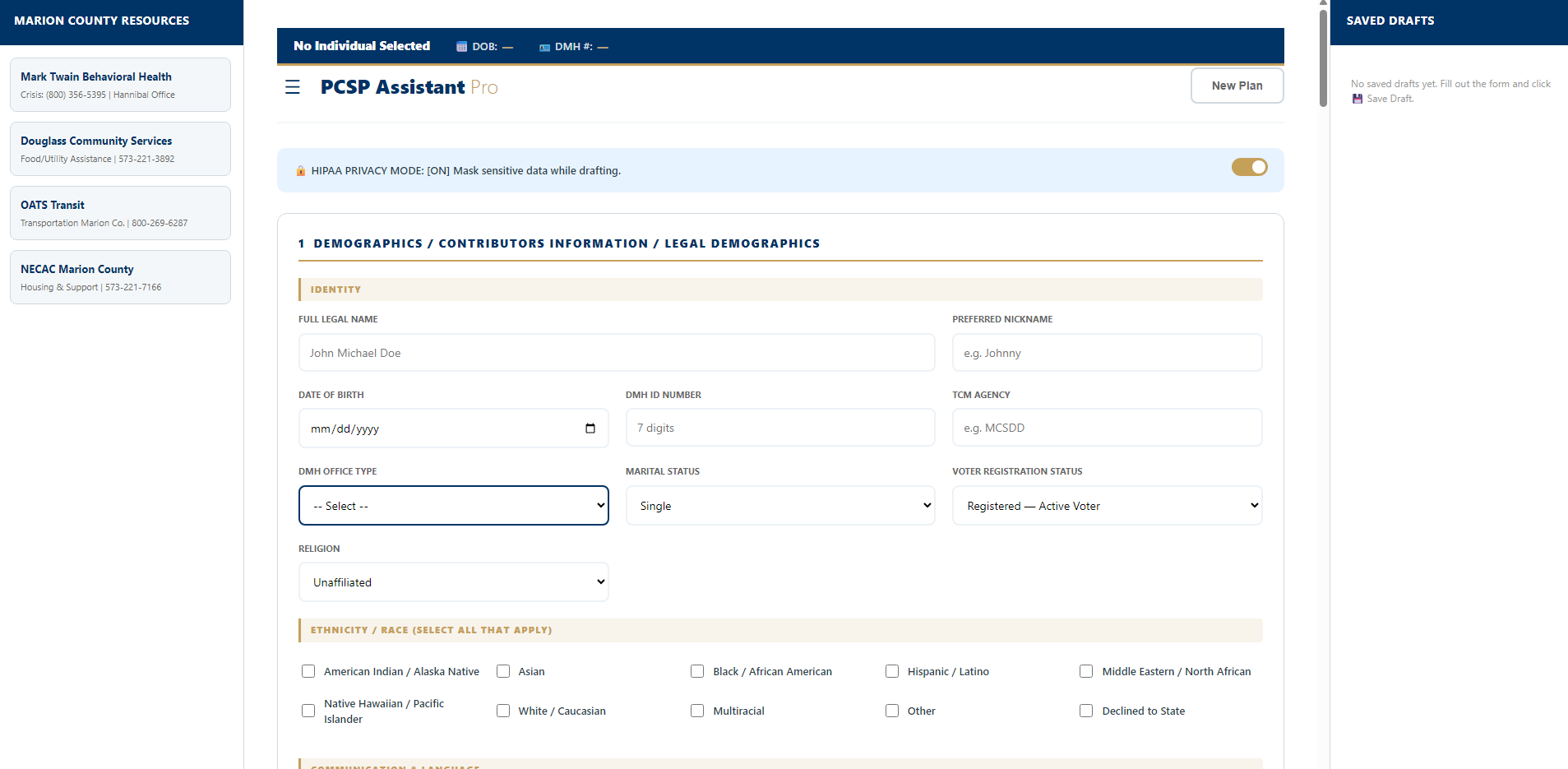
The interface covers all 18 PCSP domains in a single unified workspace, from demographics to the amendment log — with a clinical word bank, a dynamic communication chart, an unlimited important-people roster, and a multi-goal outcomes engine baked directly into the logic.
That zero-footprint design held up well for a single-device workflow. As MCSDD shifted to a hybrid work model — case managers splitting time between the office and field visits — the requirement changed: the same plan needed to open on more than one machine. That's what drove the move to a Neon-backed, zero-knowledge cloud sync, without giving up the client-side encryption the original architecture was built around.
Modular Builder
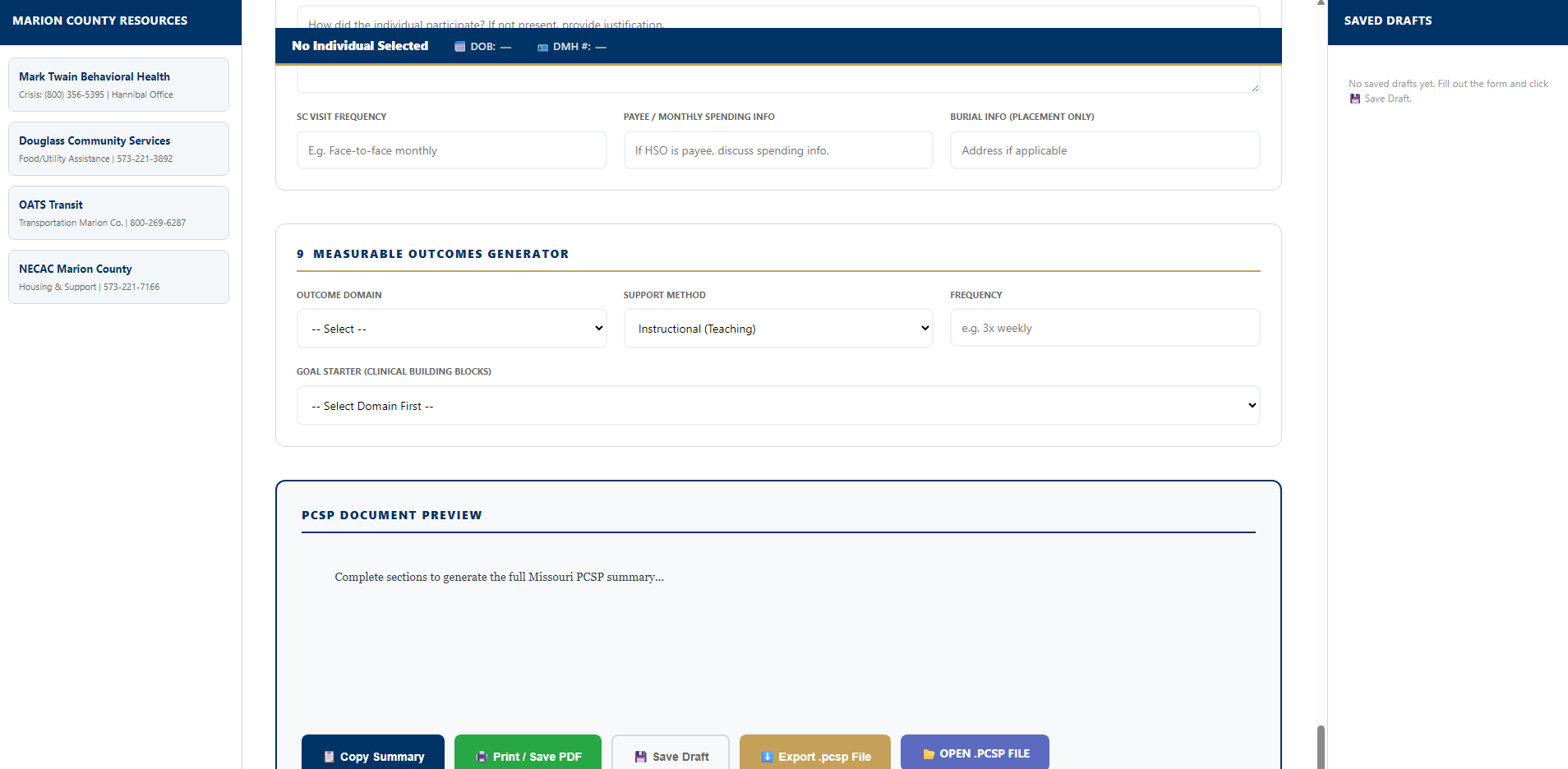
A dropdown-driven building block approach converts casual goal language into standardized SMART goals instantly. Each of the 18 PCSP sections is self-contained and collapses cleanly for focused drafting.
Zero-Knowledge Cloud
Transitioned from local-only storage to a highly secure Neon PostgreSQL backend. However, to maintain strict HIPAA compliance without a BAA, all plan data is binary-encrypted (AES-GCM 256-bit) locally in the browser before syncing. The database only ever stores opaque ciphertext.
Non-Destructive Amendments
A fully wired Amendment Log tracks changes (Moves, Service changes, Provider changes) on a dated timeline without reopening or overwriting the originally approved plan. The UI displays 'Amended' chips on affected sections for immediate visibility.
Dynamic Plan Depths
One plan, two depths. By separating waiver-status and medical-complexity into independent toggles, non-waivered clients in natural homes see a condensed UI. Irrelevant sections (like HCBS education or HRST scoring) intelligently collapse with explicit reasoning, streamlining the workflow.
Clinical Word Bank
Pre-loaded with Missouri-approved active verb structures — Instructional, Maintenance, Physical/Direct, Modeling, and Verbal Prompts — to enforce audit-ready language on the first draft.
Person-Centered Supports
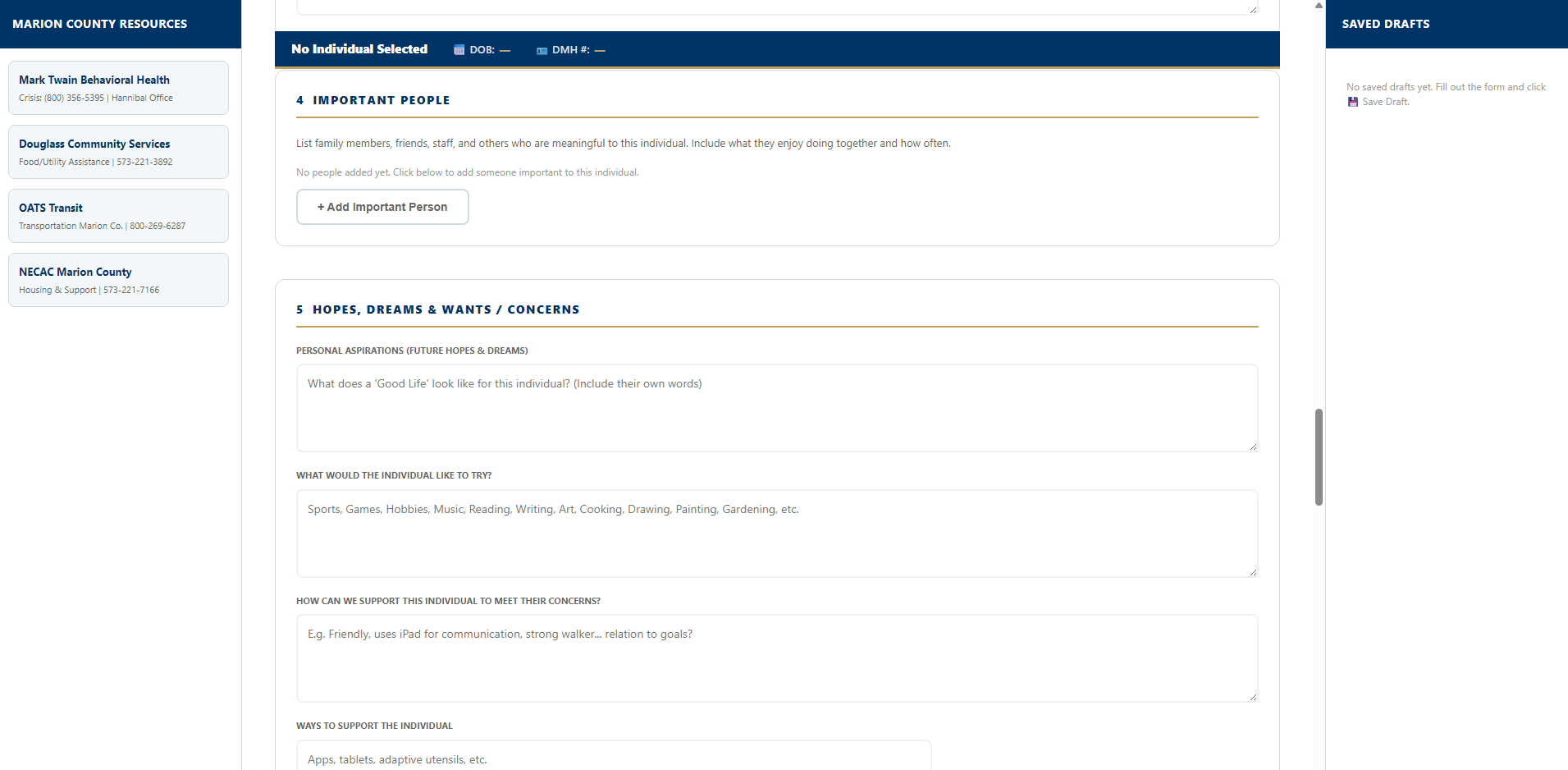
Dedicated sections for what the individual genuinely likes and dislikes, plus an unlimited dynamic roster of important people. This feeds directly into the auto-generated PDF narrative.
HCBS & Due Process
Automated workflows for federal HCBS Rule compliance and Missouri Due Process. Captures less restrictive alternatives, historical patterns, and measurable criteria for lifting rights restrictions.
Automated Compilation
The engine instantly compiles 18 complex sections into a clean, formatted PDF. Recent refinements include dynamic pagination, precise CSS alignment for side effects, and exact mapping of 'Ways to Support' into Section 10.
03 // The Execution
The execution wasn't linear. Every architectural decision was a deliberate tradeoff between compliance, usability, and maintainability — built for staff who needed a tool, not a tutorial.
Regulatory Discovery
Before writing a line of code, I conducted a full read of Missouri 9 CSR 45-3.010 and the "Good Life" Framework to map every required clinical trigger. The eighteen-domain PCSP structure, active treatment language requirements, and HCBS federal compliance rules all had to be baked into the logic.
Encrypted Cloud Migration
While the initial architecture prioritized local storage, MCSDD's shift to a hybrid work model meant case managers needed the same plan available from more than one machine — in the office and in the field. I architected a Neon PostgreSQL backend with Row-Level Security, but engineered it as a 'Zero-Knowledge' vault. The payload is encrypted in the browser using PBKDF2/AES-GCM before transmission. Neon only stores the ciphertext, ensuring total HIPAA compliance without complex IT overhead.
Amendment & Depth Architecture
Case managers needed to amend plans without losing the original approved state. I built an interactive Amendment Log that timestamps changes and tags specific sections. Simultaneously, I implemented dynamic plan depths—toggling a client as 'Non-waiver' condenses the UI and hides irrelevant compliance blocks with explanatory notes, simplifying the form without altering the underlying 18-section schema.
UI / UX Refinements
Continued iterative improvements based directly on case manager feedback. This included updating the cover sheet branding, restructuring medication side-effects for better narrative flow, removing redundant signature lines for workflow efficiency, and ensuring high-fidelity print stylesheets with proper pagination and HIPAA disclaimers.
Communication & Supports
Engineered a dynamic multi-entry system for documenting natural supports and communication profiles. Staff can add or remove people, shared activities, and behavior-to-response chart rows on the fly, satisfying strict Missouri DD compliance requirements seamlessly.
Full Section Architecture — 18 PCSP Domains
04 // The Impact
The shift from passive to active documentation wasn't incremental — it was structural. Every metric below reflects a process that no longer requires rework.
| Metric | Pre-Deployment | Post-Deployment |
|---|---|---|
| Audit Rejection | Medium Risk | Low Risk |
| Drafting Time | ~15–20 Min / Goal | ~2–5 Minutes |
| Audit Compliance | Inconsistent Active Phrasing | 100% Active Phrasing |
| IT Overhead | Complex Security Requirements | Zero (Browser Only) |
| Revision Cycles | Frequent Rejections | First-Pass Approval |
| Communication Docs | Inconsistent / Missing | Structured + Charted |
| Plan Portability | Locked to One Machine | Encrypted AES-GCM (.pcsp) |
| Data Confidentiality | Readable Plaintext | Cryptographically Sealed |
| Person-Centered Data | Freeform / Overlooked | Structured Profiles |
| Outcome Goals | Single Goal Per Plan | Unlimited Multi-Goal |
| PHI Draft Retention | Indefinite / Unmanaged | 30-Day Auto-Expiry |
| Unsaved Work | Lost on Tab Close | 4-Second Auto-Save |
| Workstation Compliance | No Session Controls | 30-Min Idle Timeout |
05 // Technical Appendix
I. Data Lifecycle Management
The primary security feature is its Stateless Architecture. Unlike SaaS platforms, this tool functions as a pure client-side processor — data exists only for the duration of the session.
All logic executes in browser RAM. Sensitive PII exists only in volatile memory during a live session, protected by a 256-bit AES session key.
Closing the tab instantly purges all session data and the derived session key. No database, no POST requests, no residual trace.
When persistence is needed, the plan state is binary-encrypted (AES-GCM) using a unique PBKDF2-derived key. The .pcsp file is a cryptographically sealed container.
Up to 20 in-progress drafts persist in localStorage on the local machine only — never synced, never transmitted. Drafts auto-expire and are purged after 30 days per HIPAA retention policy.
After 30 minutes of inactivity, the system presents a HIPAA workstation policy prompt. Dismissing it clears the auto-save and reloads — satisfying unattended workstation requirements without IT configuration.
A 4-second debounced write saves session state to localStorage after every change. A restore prompt appears on next load if an auto-save younger than 48 hours is detected.
II. Missouri Clinical Logic
Variable sanitization: user input is HTML-escaped before rendering into the DOM to prevent injection via names, relationship fields, or goal text.
III. Dynamic Data Architecture
Several PCSP sections require an unbounded number of entries — legal representatives, communication chart rows, important people and their activities, and outcome goals. Fixed forms don't work here: a client might have two guardians or six, one goal or nine. Each section manages entries as in-memory JavaScript arrays, rendered to the DOM on every state change and serialized with full fidelity on .pcsp export.
IV. Interactive UI Components
Custom lightweight multi-select dropdowns with animated tag systems handle complex, multi-dimensional data capture — learning styles, health parameters, legal authority roles — while maintaining a clean, single-page UI footprint. No framework overhead. No third-party component libraries. Every interaction is purpose-built for clinical context. Section completion indicators (green dot / gray dot) give coordinators an instant visual audit of plan completeness at a glance.
V. Output Pipeline
A dedicated print stylesheet strips all UI chrome and stamps a HIPAA confidentiality footer on every page. Outputs a clean, PCSP-formatted document ready for signature or filing.
Full plan state exported as a portable JSON-based file. Drag-and-drop or file-select auto-fills every field — static and dynamic — on re-import.
One-click copy of the full narrative summary for direct paste into CIMOR, MOEDIWEB, or any agency system.
VI. Deployment Strategy
Deployed as a static site backed by Neon Postgres, not an installed application. Case managers sign in with their own account and pick up the same plan from any machine — office desktop or home laptop, wherever the hybrid schedule puts them that day. There's still no server to patch, no license to renew, and no IT ticket to open: Neon manages the database, and because every payload is encrypted client-side before it ever reaches the network, the deployment carries the same low compliance overhead as the original single-file version. An offline mode remains available for staff working without a signed BAA or a reliable connection — Save Draft falls back to a local encrypted .pcsp export instead of syncing.
VII. v3.0 Security Protocol (Hardened)
Version 3.0 implements an encryption layer using the browser's native **Web Crypto API**. The system ensures that data is cryptographically sealed at rest and only accessible via a deterministic unlock sequence.
Note: The raw password is never stored or used as a key directly. Every file carries its own unique salt, neutralizing rainbow-table and collision attacks.
06 // Conclusion
The constraint of "no cloud tools" that initially seemed like a limitation turned out to be the design brief. Encrypt everything client-side, and the backend never has to be trusted with anything but ciphertext — that principle held whether the plan lived in volatile browser memory for a single session, or in Neon once MCSDD's hybrid schedule meant staff needed it on more than one machine. By keeping the encryption boundary in the browser instead of the server, I eliminated both the HIPAA risk and the IT bottleneck from day one — and kept them eliminated through the move to the cloud.
The result covers every Missouri PCSP domain, satisfies HIPAA's Security Rule without a BAA, enforces PHI retention policies client-side, and gets case managers from blank page to audit-ready narrative in a few minutes instead of twenty. That's the kind of problem frontend engineering is uniquely positioned to solve.